yeovil at War
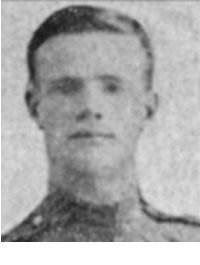
William blake
Killed in the build-up to the Second Battle of Ypres
 In
truth there is
some little
confusion
concerning William
Blake. He is
referred to in
military records
as William
Blake, son of
George Blake.
However civil
records only
refer to William
in the 1911
census. There
was also a John
William Blake of
Yeovil, son of George
Blake. As far as
I can ascertain
there was no
other George
Blake in Yeovil
during this
period.
In
truth there is
some little
confusion
concerning William
Blake. He is
referred to in
military records
as William
Blake, son of
George Blake.
However civil
records only
refer to William
in the 1911
census. There
was also a John
William Blake of
Yeovil, son of George
Blake. As far as
I can ascertain
there was no
other George
Blake in Yeovil
during this
period.
To further complicate matters there was a contemporary, William George Blake of Yeovil, son of Elias Blake. This William, known as George, was killed in the Great War and his name is on the War Memorial in the Borough.
This page therefore assumes that William Blake, son of George, was neither John William Blake nor William George Blake.
William Blake, was born in Yeovil in 1882, probably the son of labourer George Blake (b1844) and his wife Mary (b1846) but I found no other information.
 William
was a career
soldier, which
probably
accounts for his
lack of presence
in civilian
records. The
first census he
appears in was
in 1911 when he
was listed as a
29-year old
Gunner of 7th
Battery, Royal
Field Artillery.
His Service
Number was
18705. At this
time he was
stationed in
India, but it is
not known where
he was stationed
or when he
returned to
England.
William
was a career
soldier, which
probably
accounts for his
lack of presence
in civilian
records. The
first census he
appears in was
in 1911 when he
was listed as a
29-year old
Gunner of 7th
Battery, Royal
Field Artillery.
His Service
Number was
18705. At this
time he was
stationed in
India, but it is
not known where
he was stationed
or when he
returned to
England.
In August 1914 William was a Gunner and part of 99th Battery, 24th Brigade, Royal Field Artillery. It was mobilised and on 10 September was sent to France with the British Expeditionary Force, landing at St Nazaire.
The 24th Brigade moved at once to the Aisne to reinforce the hard-pressed BEF. They moved north to Flanders and were in action at Hooge in 1915.
For much of the war, the region around Hooge belonged to one of the eastern-most sectors of the Ypres Salient, being almost constantly exposed to enemy attacks from three sides. From 1914 the front line of the salient ran through the Hooge area and there was almost constant fighting in the region over the next three years, during which the village of Hooge was totally destroyed. Around Hooge, the opposing front lines were almost within whispering distance of each other. With its ruined village and a maze of battered and confusing trench lines, the area was regarded as a very hazardous and heavily contested area for the infantry, where snipers abounded and trench raids were frequent. Both sides saw Hooge as a particularly important area and a key target for heavy artillery bombardment.
William was wounded in the build-up to the Second Battle of Ypres (22 April – 25 May 1915) and evacuated to the No 4 British Expeditionary Hospital, housed in the Trianon Palace Hotel, in Versailles, France. William Blake died from his wounds in the hospital on 29 March 1915. He was aged 33.
His name was added to the War Memorial in the Borough in 2018.
gallery
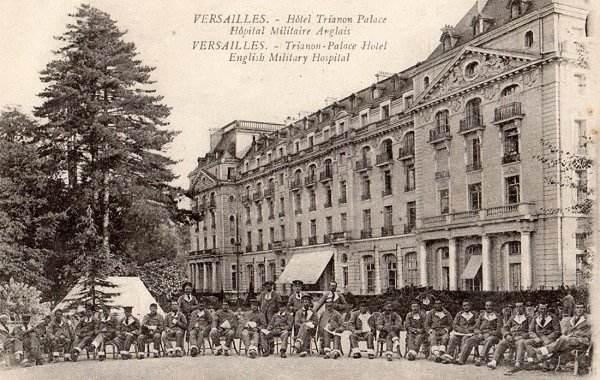
Recuperating British troops at the Trianon Palace Hotel, Versailles, commandeered as the No 4 British Military Hospital, where William Blake died on 29 March 1915.
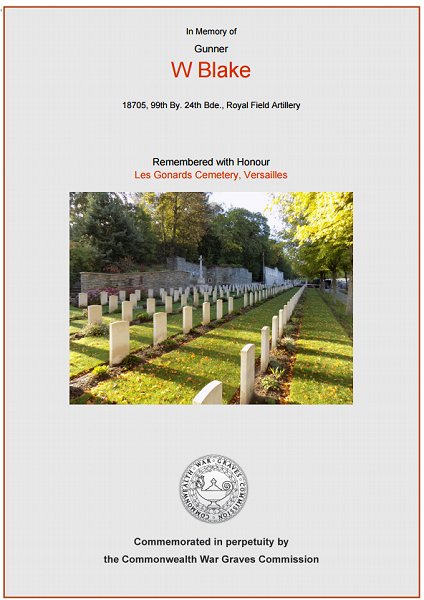
The Commonwealth War Graves Commission certificate commemorating William Blake.
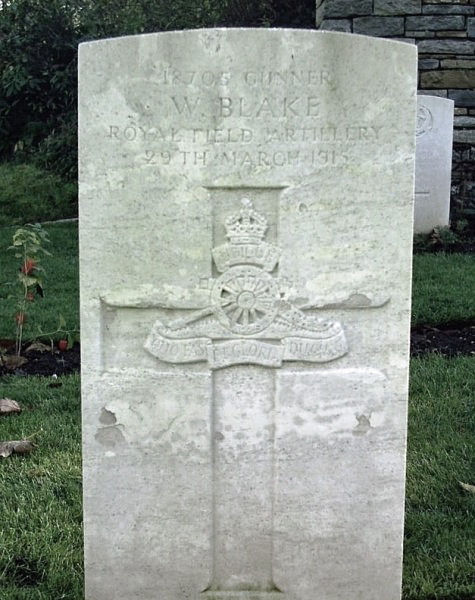
William Blake's headstone at Les Gonards Cemetery, Versailles, Yvelines, France.