Yeovil's Museums
Yeovil's Museums
Through the ages
Probably Yeovil's first museum was located in the Angel Inn which stood on the corner of Hendford and Porter's Lane (now Westminster Street) facing High Street and the Borough - the site is now occupied by the Westminster bank building.
In 1761 Edward Forbes, licensee of the Angel Inn, was the proud owner of a celebrated 'museum' in the kitchen of the inn. Included among Mr Forbes' curiosities was a panel now housed in the Community Heritage Access Centre at Lufton. It is of painted and gilded gesso on oak boards. In the Western Flying Post's edition of 1 January 1779, the Angel Inn was advertised as 'famed for its beautiful kitchen and repository of curiosities'.
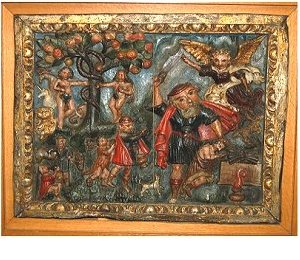 The
carved and
coloured panel,
photographed at
left, is thought
to date to 1603 and
is believed to
be possibly the
work of Humphry
Beckham (d1671)
of Salisbury. It was
once hung up in
the kitchen of
the Angel Inn as
part of Mr
Forbes'
'museum'. It
depicts Old
Testament scenes
of Adam and Eve
in the top left
corner, while
the remainder is
devoted to the
story of Abraham
and Isaac. Adam
and Eve are
depicted holding
nine leaves in
front of them
while a serpent
entwines the
apple tree under
which they
stand. Eve
offers an apple
to Adam, who is
about to accept
it. On his right
are a stag, a
unicorn and a
lion, while
below his bent
left knee is an
elephant. In the
lower part of
the panel is the
beginning of the
Abraham and
Isaac story.
The
carved and
coloured panel,
photographed at
left, is thought
to date to 1603 and
is believed to
be possibly the
work of Humphry
Beckham (d1671)
of Salisbury. It was
once hung up in
the kitchen of
the Angel Inn as
part of Mr
Forbes'
'museum'. It
depicts Old
Testament scenes
of Adam and Eve
in the top left
corner, while
the remainder is
devoted to the
story of Abraham
and Isaac. Adam
and Eve are
depicted holding
nine leaves in
front of them
while a serpent
entwines the
apple tree under
which they
stand. Eve
offers an apple
to Adam, who is
about to accept
it. On his right
are a stag, a
unicorn and a
lion, while
below his bent
left knee is an
elephant. In the
lower part of
the panel is the
beginning of the
Abraham and
Isaac story.
In 1761, Richard
Gough wrote "The Angel Inn is celebrated over this County for
its
Kitchen,
a large
room
originally
intended
for ye
purpose,
but by
ye
present
Landlord,
Mr
(Edward) Forbes, furnish't
with the
greatest
variety
of
curiosities,
rare
china,
and
earthen
ware
painted
with
different
subjects,
many
American
weapons
and
Animals,
models
of ships
and ye
Holy
Sepulchre,
various
English
Fossils
and
other
natural
curiosities,
Lava
from
Vesuvius,
Lamps
from
Herculaneum,
etc.,
etc.
Against
ye Grate
which is
in ye
proper
form but
extremely
neat is
fixt ye
portrait
of an
old
Serjeant,
an
Acquaintance
of Mr
F's on
horseback.
To keep
up ye
appearance
of a
Kitchen
there is
pewter
and
other
parts of
Kitchen
Furniture
about
it, and
some
closets
to serve
as
pantries,
but ye
work is
done in
a back
Kitchen.
Here are
also two
large
tables
of a
beautiful
but
coarse
yellow
marble
sprinkled
with
different
coluirs,
spots
and
veins,
dug out
of a
neighbouring
field of
Mr F's,
some
coarser
blocks
of ye
same are
cut into
steps.
The
Landlord
discovers
very
little
appearance
of his
profession
and his
whole
delight
consists
in the
singular
room.
The
business
is
principally
carried
on by
his
nephew
who is
to be
his
heir."
Bodleian
Library
- Gough
Nichols
MSS
Top.Gen.
e23 ff
141-2.
'Private
Museums'
written
by
Richard
Gough,
c1761.
In June 1923, William Wyndham, a former Vicar of Yeovil, gifted 28 Kingston to the town, including his collection of Yeovil artifacts and Henry Stiby's collection of guns (see Gallery). At a meeting of the Corporation, Mr Wyndham was thanked for his generosity and the Corporation decided that the gift should be called the Wyndham Museum. The museum was originally the billiards room of 28 Kingston. The museum formed the origins of the later Yeovil Municipal Museum. When the house became the Rural District Council offices, the museum exhibits were divided between the Yeovil School in Goldcroft and the new museum in King George Street.
The municipal museum was created above the Borough Library at the southern end of the new municipal buildings in King George Street, chiefly in order to display the Roman finds from the Westland Roman Villa site, including the mosaic floor.
Then, (I think) in the late 1970s or early 1980s, the town's collection of artifacts was housed in the Hendford Manor Coach House for many years.
Yeovil has a vast collection of artefacts relating to its history, recently in the custodianship of the South Somerset District Council. Since 2011 these have been kept in a facility on a trading estate at the edge of town (the former Community Heritage Access Centre, or CHAC, now called the South Somerset Heritage Centre). Even though Chard, Crewkerne, Ilminster, Castle Cary and Bruton have their own museums, Yeovil still has only this remote facility.
June 2021 -
because of the
lack of a 'real'
museum,
this
website has now
been re-branded
as -
Yeovil's Virtual
Museum

gallery
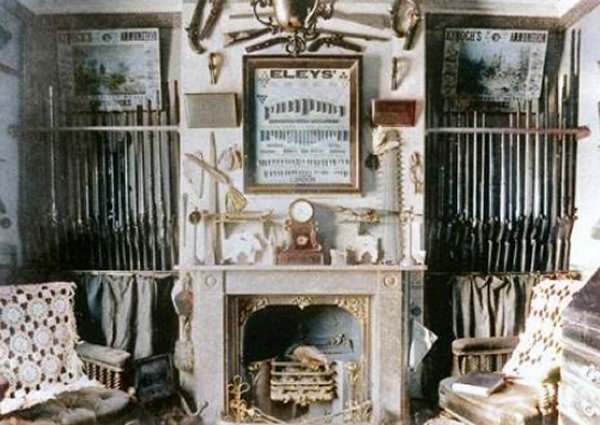
A colourised photograph of Henry Stiby's study at 5 The Park. His gun collection was donated to the Wyndham museum and is now, most sadly, locked away in the council's store at Lufton.
From the Cave
Collection
(colourised),
Courtesy of South Somerset Heritage Collection
The Wyndham Museum was originally the billiard room of No 28 Kingston. The museum was the gift of William Wyndham to the town and formed the origins of the later Yeovil Museum.
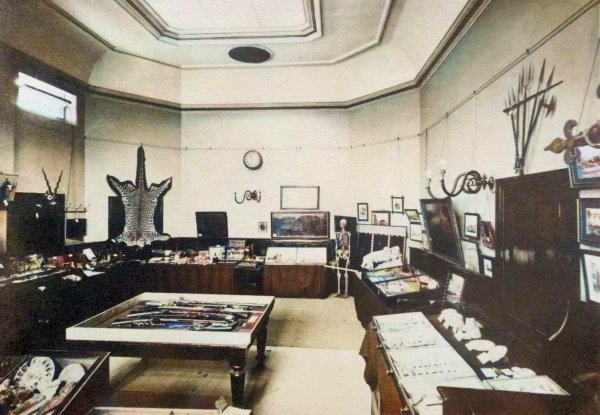
From the Cave
Collection
(colourised),
Courtesy of South Somerset Heritage Collection
The Wyndham Museum in the former billiard room at 28 Kingston. The museum was later housed in the municipal offices in King George Street (see next photo) and then in the coach house of Hendford Manor. Today it is all locked up in Artillery Road and, although it is still accessible by appointment, how awful is that! Photographed before the dispersal of the exhibits in 1928.
From the Cave
Collection
(colourised),
Courtesy of South Somerset Heritage Collection
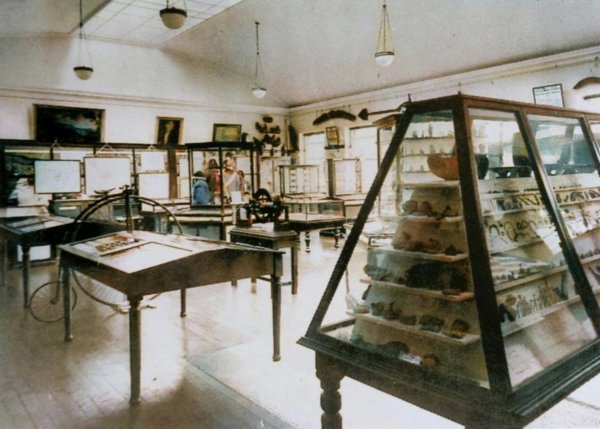
Photographed in the 1960s, this was the museum in the municipal offices in King George Street. When I knew it in the late 1970s, this room housed the council's engineer's drawing office. The room was on the first floor, at the southern (South Street) end of the building.
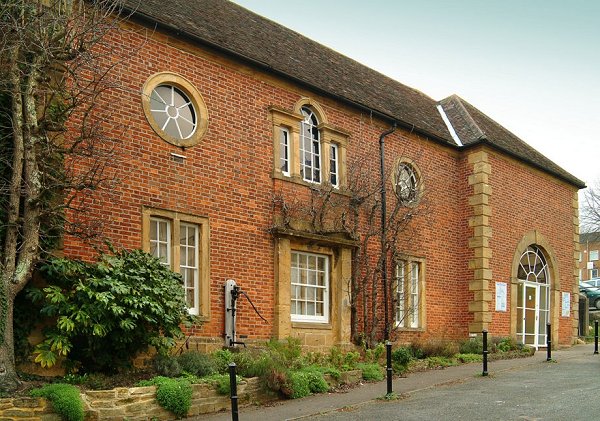
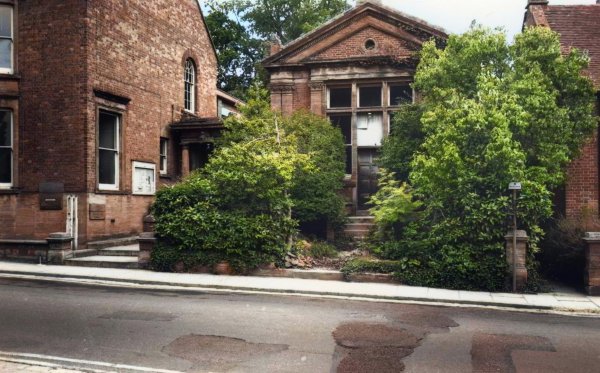
Hendford Manor Coach House, photographed in the late 1990s, when it housed Yeovil's museum.